Technically, It Is Already Here
I have written around this idea before. In The Price of Software Just Hit Zero I argued that building software was becoming nearly free. In Database in a Trenchcoat I argued that most SaaS interfaces would be swallowed by the AI workspaces. Both were, at the time, predictions.
Over the last weeks, technically at least, they stopped being predictions.
The models got better again, fast. GPT-6. The Claude 5.5 models. Gemini Argon 4. It is getting hard to wish for more when it comes to an AI doing your software job for you. The clearest signal for me is personal: with the Claude 5.5 models I almost never correct them anymore. They start, keep their train of thought, and execute. They run long, self-sustained tasks, and you get the software you asked for.
So here is the thesis, stated plainly.
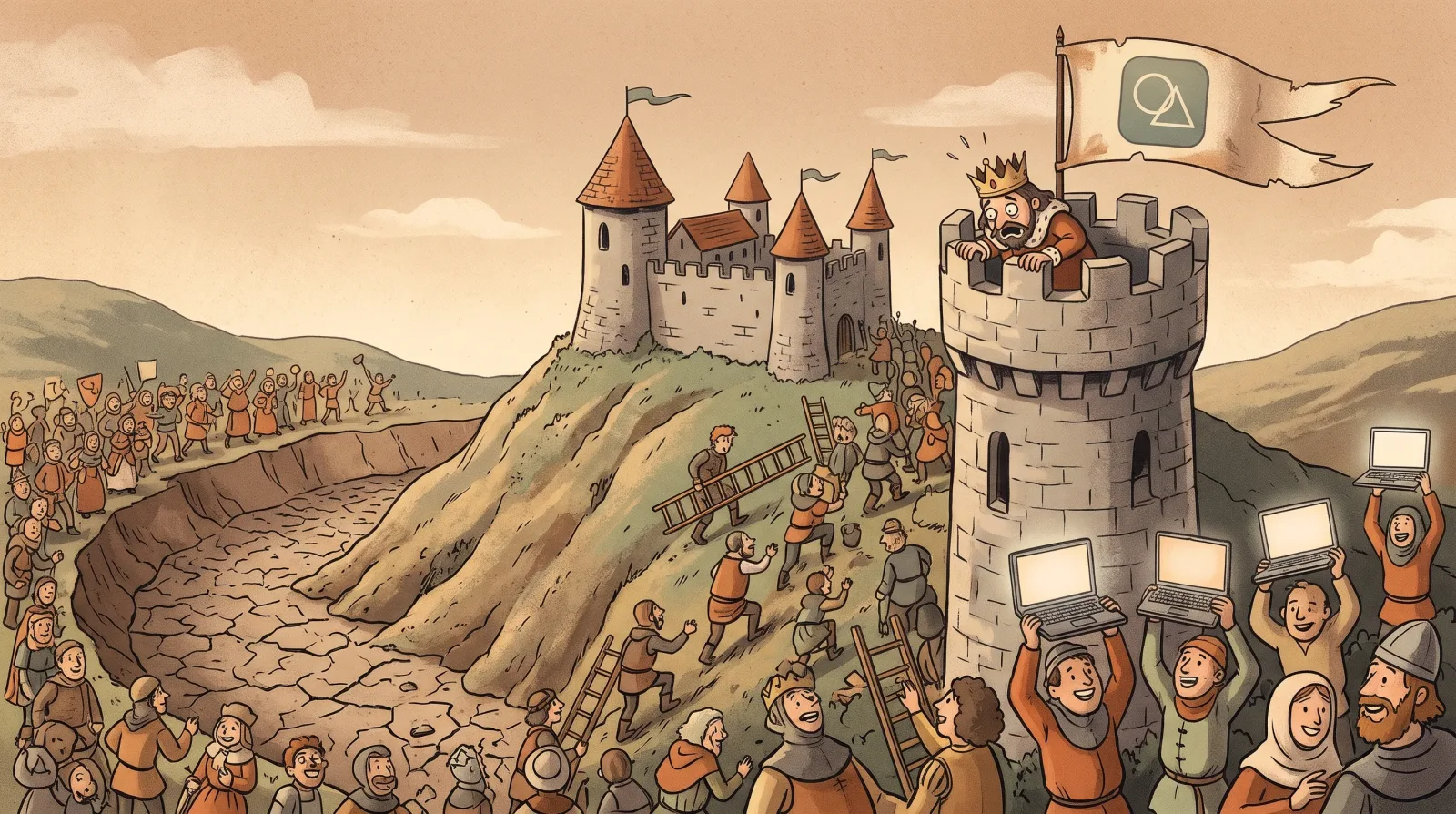
Having a good software product no longer gives you a moat. Technically, that is already true. The market just has not caught up.
I want to be precise about that. I am not saying the market has already shifted. It has not. Most people have not yet realised that software has become almost free to build, and people, habits, contracts and organisations take years to adapt. What I am saying is that the technical barrier is gone. The rest is humans catching up, and over the next few years they will.
Seven Adobe Apps in a Few Weeks
The example that made it real for me is ArtCraft. It started as one developer, Brandon Thomas, and has grown into a small team. Between late September and early October they published free, open source rebuilds of Photoshop, Illustrator, Premiere, Lightroom, After Effects, InDesign and Acrobat. Built with Claude. Written in Rust, so they are as fast as they can be.
My first reaction was the same as most people’s. Sure, anyone can claim that. I wonder if it works.
It is early. The project’s own documentation says real feature parity is still well below half, and the apps are in alpha. But they have kept hammering away, week after week, and I now see more and more people actually switching. Not developers playing with a toy. People who use these tools for work, saying it is good, and that it is brilliant.
The quality today is not the point. The direction is. A handful of people did in weeks what used to be a decade of work for thousands of engineers.
Why GIMP Never Hurt Adobe
The obvious objection: open source alternatives to Photoshop have existed for twenty-five years. GIMP, Krita, and many more. Adobe is still here, still charging premium prices.
Why did they not win the market? Habits.
Every one of those alternatives asked you to learn a new tool. Different menus, different shortcuts, different mental model. Your hands knew Photoshop. Your brain knew where things were. That knowledge, built over years, was the real lock-in. Not the features. The muscle memory.
This is what makes ArtCraft different, and a bit renegade. They buried their pride. They did not try to build a better image editor with their own ideas about how it should work. They went for a one-to-one carbon copy of the interface, the menus, the feel. The project reports that every one of Photoshop’s 625 menu items is wired up.
When the copy looks and feels like the thing you know, your habits come with you. And then the question becomes very simple.
If it looks, feels and works like what your hands already know, what is holding you back from leaving a really expensive subscription?
Is Adobe safe in the short term? Yes. Habits and enterprise contracts buy time, and nobody goes bankrupt tomorrow because of an alpha release. But Adobe sells a premium package, and the only thing between a customer and a free copy that feels the same is now the price. That is not a moat. That is a countdown.
I should be honest about one thing. In Database in a Trenchcoat I listed creative tools as survivors, because the act of making is the point. I still think the experience survives. I no longer think the vendor automatically does. If the experience can be copied, it can be given away.
The Legal Grey Zone
This raises questions nobody has had to answer before. ArtCraft says the apps are clean-room reimplementations: no Adobe source code, nothing stolen. Clean-room reverse engineering has generally been accepted. The weaker points are elsewhere: the look of the interface, Adobe’s license terms, patents and trademarks. None of it has been tested in court, and as far as I can see, Adobe has stayed quiet so far.
What is piracy when you build the whole thing yourself? I do not know. But I notice that the question used to be theoretical, because nobody could afford to rebuild Photoshop. Now it is a practical one.
So What Is Left?
If the product can be copied, interface and habits included, what still protects a software company? My answer is three things, and none of them are software.
- Relationships. With your customers, and especially with the people who decide what gets bought and used. A clone can copy your feature list. It cannot copy the trust of the buyer who has worked with you for ten years.
- Brains. Habits still matter where they are tied to something other than the interface: a brand people trust, a name that means something, a way of working a whole organisation is built around.
- Data. The data you have collected over years, which no one can go back and collect again.
The AutoUncle Test
It would be cheap to say this about Adobe and not about my own company. So let me run the test on AutoUncle.
Say someone pointed GPT-6 at AutoUncle and cloned the entire website in a month. Every page, every feature, every flow. I think that is realistic now. What would they still be missing?
The data. We have been gathering car market data for years and years. You cannot go back to 2015 and train the valuation model on that market’s data. That history is what makes valuations good, and it does not exist anywhere else.
The customers. The dealers we work with, and the relationships behind them. Those were built one conversation at a time, and they do not transfer with the source code.
The brand. We set out to be the trusted uncle. We were the first company in the world to publish car valuations openly, and we invented the price rating. A clone would have a very hard time becoming the authoritative stamp that verifies whether a car is fairly priced. That kind of authority is earned over years. It cannot be generated.
Our software is good, and I am proud of it. But I do not believe it is our moat anymore. It is the cloak over the things that are.
The Trojan Horse
There is a second force eating away at software companies, and it comes from the big labs.
ChatGPT Work and Claude Cowork are taking over more and more of the user experience. Users do not leave the chat, and the chat keeps getting more interactive. On 7 October OpenAI shipped GPT-6 with Intelligent UI: calculators, charts, maps and buttons generated right inside the answer.
MCP is how software companies plug into that world. You expose your data and your actions so the AI can use them on your customer’s behalf. And that is the Trojan horse. The software that owns the experience today ends up as a database and a data source plugin.
That was the whole point of Database in a Trenchcoat. Most of these products were always a database with a thin layer on top, and that thin layer is what goes away. The labs do not take over the trenchcoat. They take the interface. Everyone else is left being the database.
I want to be clear: I support MCP, and I do not think there is an alternative. If your customers live in ChatGPT or Claude, you have to be there. But if you build a plugin to serve your customers inside one of those tools, do not expect anything other than the whole experience moving there, eventually. Who wants to use ten different pieces of software if they can use one?
The Last Mile Is Memory
So is being the data source a moat? I am honestly not sure. And I have a prediction about why it might not be.
Language models are stateless. Every inference run starts from scratch, as if it has never met you. That is simply how they work. The memory features the labs build on top are bolted on: something gets fetched and injected into the context with a couple of calls. The labs know exactly what stands between them and taking everything. It is whether they can gather and keep knowledge about you, on a personal basis.
That is why they are all racing toward a personal agent right now. xAI put Grok Bot in beta in August. Meta launched Muse in September. OpenAI followed with Dots, and last week Anthropic announced Claude Duet. They all know they have to own data persistence if they are going to go the last mile, and own not just the interface but the whole thing.
If they get there, being the data source is a thinner moat than it looks today. The data that only you have, like years of market history, still counts. The data that is really about your customer may end up living with the customer’s agent instead.
One Layer Down
The same thing is happening inside the code. In Everything Falls to Rust I wrote about how agents hardly ever reach for a library anymore. The Rails reflex of “there’s a gem for that” is gone. Agents just build it. And they can rebuild a whole existing system from scratch, in whatever language suits it, cheaply enough that sticking with what you have is a choice rather than a necessity.
That is not a quirk. It is the same loss of moat, one layer down. Open source libraries were valuable because building the thing yourself was expensive. Now anything can be built, and the agents do build it. If even a well-loved library cannot hold its position against “just write it”, a SaaS product built on the same economics will not either.
That post is the mechanism. This one is the consequence. If anyone can rebuild any product in weeks, in whatever language suits it, and ship changes almost instantly, the product stops being the thing that protects you. Not overnight, because people and habits move slower than technology. But the direction is set.
The Open Question
Which leaves the part I have not figured out, and I would rather ask it honestly than pretend I have.
What does this mean for startups?
For as long as I have worked in software, the playbook for a startup was: build a better product, and go take the market. The incumbent was slow, the newcomer was sharp, and the better product won. That is how most of the companies we know today got started.
But a startup begins with none of the things I listed above. No data. No customer relationships. No brand. And it is entering a world flooded with really good software, where a great product is no longer rare enough to win customers on its own.
Maybe the answer is distribution. Maybe it is trust, earned in a niche before anyone else shows up. Maybe it is owning a narrow slice of data early and growing from there. I do not know yet.
So I will put it to you. If the product is no longer the moat, how do you go to market with a new one?