Mission Accomplished
Last week my brother Johan and I recorded episode 14 of Johnny’s Garage, our podcast. Johan spent sixteen years co-founding and running AutoUncle as CEO. These days he builds things in our codebase. When we sat down, he said he felt wound up.
I knew exactly why, because I had been on the receiving end of it all week. He kept sending me things he had built, ideas he had shipped, things he wanted to ship next. The day before, I had typed out a reply that started with “what the hell is this crap”, looked at it, and deleted it.
The funny part is that this is exactly what I have been working toward. My job for the past year has been to make it possible for everyone at AutoUncle to contribute to the product with what they know. I wrote about that in Everyone Produces Code Now. So in a way, it is mission accomplished.
It is also the first symptom of something I see again and again, in other people and in myself.
Who Has Always Vibe Coded?
I am part of what I would call a self-help group for other lunatics who have taken the AI pill and run companies. The night before the recording, someone there asked: who has always vibe coded?
His answer was CEOs. They have always said “I want a new online bank”, and three months later they got one.
The difference now is that the three months are gone. Johan built our license plate lookup in a day, from idea to production. He cannot read or write code. He described what he wanted, the agent built it properly, and we shipped it.
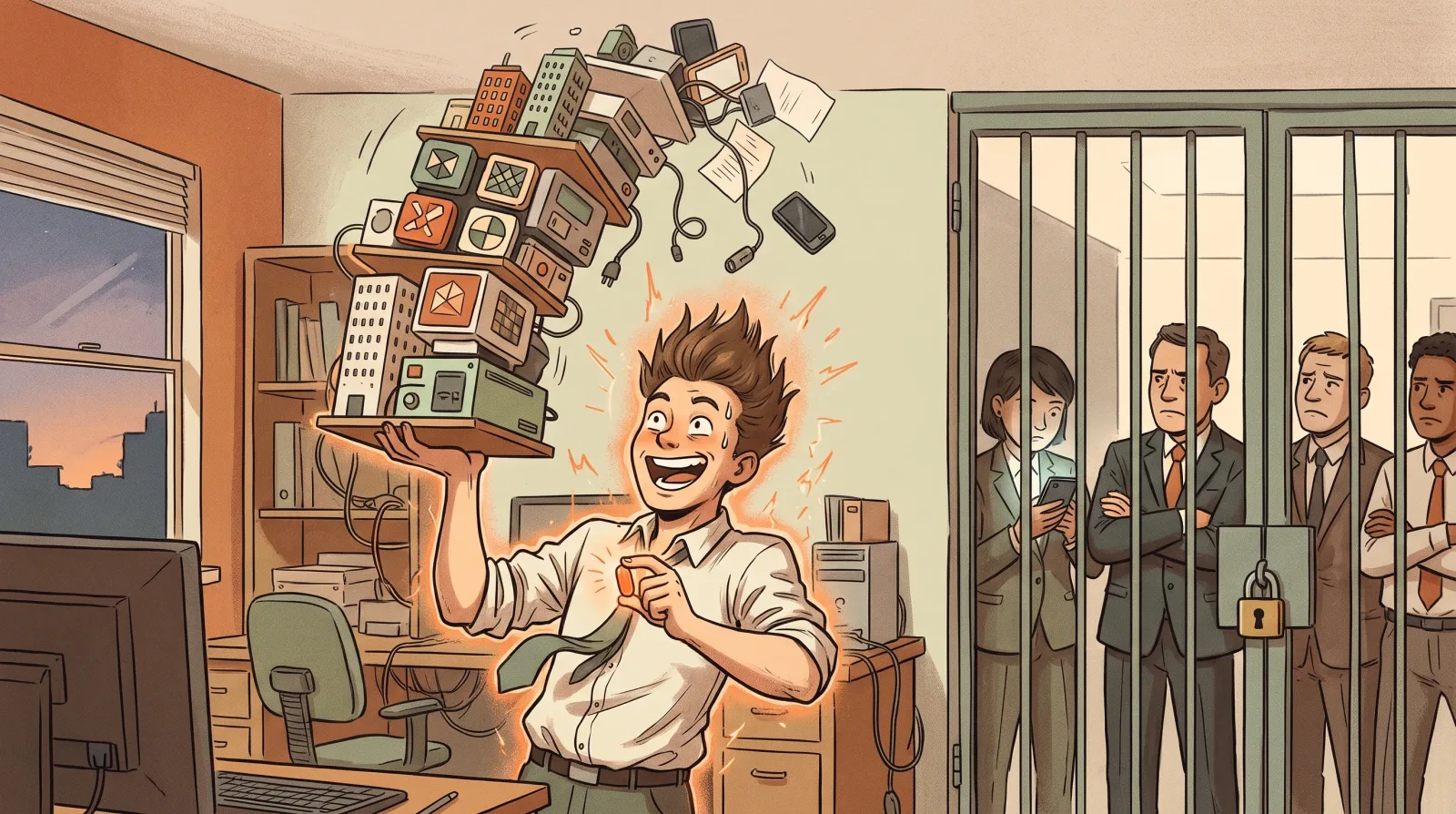
That is the pill. Once you have taken it, you get a certain wide-eyed look. Holy shit, now I can get everything I always wanted. It does not matter whether you were the CEO who felt the development department was too slow, the product manager with a backlog nobody would prioritise, or the frontend developer always waiting on the backend people. Now you can do all of it yourself, just by asking.
And so you do. You build this, and this, and this, and this. The result is an explosion of software and features.
Easier, and Somehow More Work
Here is the paradox. AI made almost everything easier, and I ended up working more than I ever have. I have heard the same from many really smart, skilled people I know.
The tools did not give us our evenings back. They gave us a bottomless list of things we could now do, and we said yes to all of it.
I do not think that is a personal failing. I think it is a phase, and like most phases, it has an other side.
The Old Lesson, for New Reasons
At the end of that journey there is a realisation, and it is not new. It is scope creep. It is saying no. These are some of the oldest lessons in software, and we are learning them again for different reasons.
Before, the reasons for saying no were mostly technical and inward-facing. If we keep adding scope, we will never finish. It will cost too much. We will drown in maintenance. Product questions mattered too, of course, but the slow pace protected us from the worst of it. When everything took months, only the things that really mattered got built. Slowness was a filter, even if nobody designed it as one.
Now the filter is gone, and the reasons for saying no have moved. Is this fit for purpose? Will people actually use it? Is this what we sell? Is the product story still clear when we have added six more things to it?
That is a much harder no to say, because the old excuse is gone.
Boris Cherny, who created Claude Code, has said he no longer writes code himself, and that what is left of the job is directing agents, understanding users and deciding what to build. Read that last part again. Deciding what to build is mostly deciding what not to build. The agents always want to build more.
Johan put his finger on it from the other direction. As a CEO, he spent years learning not to meddle. Everyone knows the seagull manager, who swoops through the office, drops a little bit of himself on everything, and leaves again. Staying out of other people’s domains came from a deep respect for them. Now he can build the thing himself in a day, and he is honestly unsure whether he should. That is the new question in its purest form.
We Are Wired to Add
I recently read a book by the Danish author Morten Münster about the greatness in being average, and the value of getting the basics brilliantly right. He refers to a study published in Nature where people were asked to improve something. The vast majority tried to improve it by adding things. Only a small minority thought to remove something. The researchers called it subtraction neglect.
There is something in human nature that makes us want to add more and more. The agents have inherited that from us, and on top of it they are built to please. They will never look at your request and ask if you really need it. They will happily build the next feature, and the one after that.
This is why I do not think it is fixable by adding a “keep it simple” skill to your harness. The urge to add is buried deep in our mental model and in the way the models approach work. A prompt tweak only scratches the surface. I do not have the fix. I only know that it is a problem, and that nothing holds it back anymore.
The Same Pattern, One Layer Down
You can see the same thing in how we manage the agents themselves. I wrote about this in Agents Don’t Care Who’s the Project Manager. Every time a new model ships, the quirks we built complex harnesses, sub-agents and orchestration layers to work around get baked into the model. The scaffolding stops solving a problem and just fills your head with complexity.
The big labs say the same thing in almost every best-practice guide that comes with a new model. Set higher-level goals. Do less micromanagement and less up-front specification. You get better results.
This is situational leadership, a well-known idea in management. Juniors need clear instructions. As people grow more senior, they want more autonomy and higher-level goals. The models are getting more senior, so the way we lead them has to change too. It is the same thing I described in The Humility Gap: our most senior engineers had the hardest time letting go of control.
Whether it is features or harnesses, the mature move is the same. Subtract.
The Teenage Years
The best metaphor I have is being a teenager. For a while you try everything. You stay out too late and get drunk every single weekend. Then comes a period of settling down, where you figure out that you should not do everything, and you start asking what you actually want instead.
That is the experience I see everyone in software go through once they are on the other side of the pill. The question is what the grown-up version looks like.
In the podcast I said that I think there will be a new normal, where we again learn how to get leverage through other people. But it will be at a smaller scale and much more hands-on, because there is a limit to how much a human can hold at once. The bottleneck has moved from what the machine can build to what we can absorb, decide and keep an overview of.
Meanwhile, Half the World Is Not on the Train
All of this is a problem for the people who have taken the pill. A lot of organisations have not, and they have a different problem.
This week the Swedish Transport Administration, Trafikverket, stopped employees using ChatGPT and Claude for work. An internal review had found what they called problematic use. People were using the tools without a business agreement in place, which in practice means personal accounts, often free ones, with completely different terms than the business versions. Copilot is still allowed, because they have an agreement for it. A limited group can still use ChatGPT and Claude through a sanctioned platform.
The headlines made it sound like the AI is dangerous. When I sent the article to Johan, even he said he understood the decision. But the technology is not the problem here. This is good old shadow IT. Everyone wants help from AI, nobody bought the tools, so people use whatever they have on their phone. It would be like blaming Gmail when someone emails sensitive data to the wrong person.
Most of the fear I meet is a misunderstanding. AI is a server call, like any other internet service you already use. The same security rules apply as everywhere else: who gets the data, under what agreement, and where it is stored. The fear that your data gets used for training, and that you cannot know what happens to it, is not a problem with business agreements. It is a problem with the subsidised free tools. It is like YouTube without a paid plan. If you do not pay, you get the ads. With free AI tools, you pay with different terms.
It also matches something we talked about in the podcast, and something I see every time I give a talk about AI. So many people and companies are stuck at the platform, because of fear or lack of knowledge. And many of them think they are on the train because they bought a Copilot license. Often it turns out to be the non-agentic version, so they believe they have bought AI while getting very little of what is actually happening right now. The resistance in the ranks was never dealt with, nothing really moves, and the people who want to use AI end up doing it on the side. In a Microsoft country like Denmark, that is a real risk. We get stuck, and we fall behind again.
And Denmark is just a small version of a bigger story. Europe is falling behind in the AI race, and a lot of it is not about the technology at all. It is the same pattern at continental scale: fear, headlines that confirm the fear, blocking instead of buying, and a feeling of safety from having ticked the box with the incumbent vendor. While we hesitate, the people and companies on the train keep compounding their lead. I wrote about the quiet side of that in They Don’t Feel It. Yet.
Two Ditches
So there are two ways to get this wrong.
You can take the pill and drown in everything you can suddenly build. Or you can stay off the train, block the tools, and watch your people use them anyway, without any of the safety you could have had. As Johan put it, the problem comes when you do not lean in properly.
You cannot skip the teenage years by locking the door. The organisations that get to a mature, sustainable normal will be the ones that let their people through the phase and then help them grow out of it. That means proper agreements, so people have a safe place to do it. It means learning in the open, from ambassadors who use the tools where everyone can see it, rather than sending people to Sunday school. And it means treating it as the change it is. A Copilot license is not an AI strategy.
None of that is new. It is classic change management, and the same old virtues. Just because it says AI on the change does not mean the reality of change is different. The virtues just matter more now.
Listen, and Tell Me
I do not have a neat solution to any of this. It is an observation that it is a problem, and one that almost everyone I talk to recognises.
What does it mean to say no, when you can have anything? How do you settle with less, and find a pace that is sustainable for your own sanity? And how do you get tools that are built to please you to help you subtract instead of add?
Johan and I talk through much of this, from CEO to programmer and back again, in episode 14 of Johnny’s Garage. It is in Danish.
You can also find it, with a full transcript, on human-context.com, or read more about the podcast here.
I would love to hear how you are handling it.