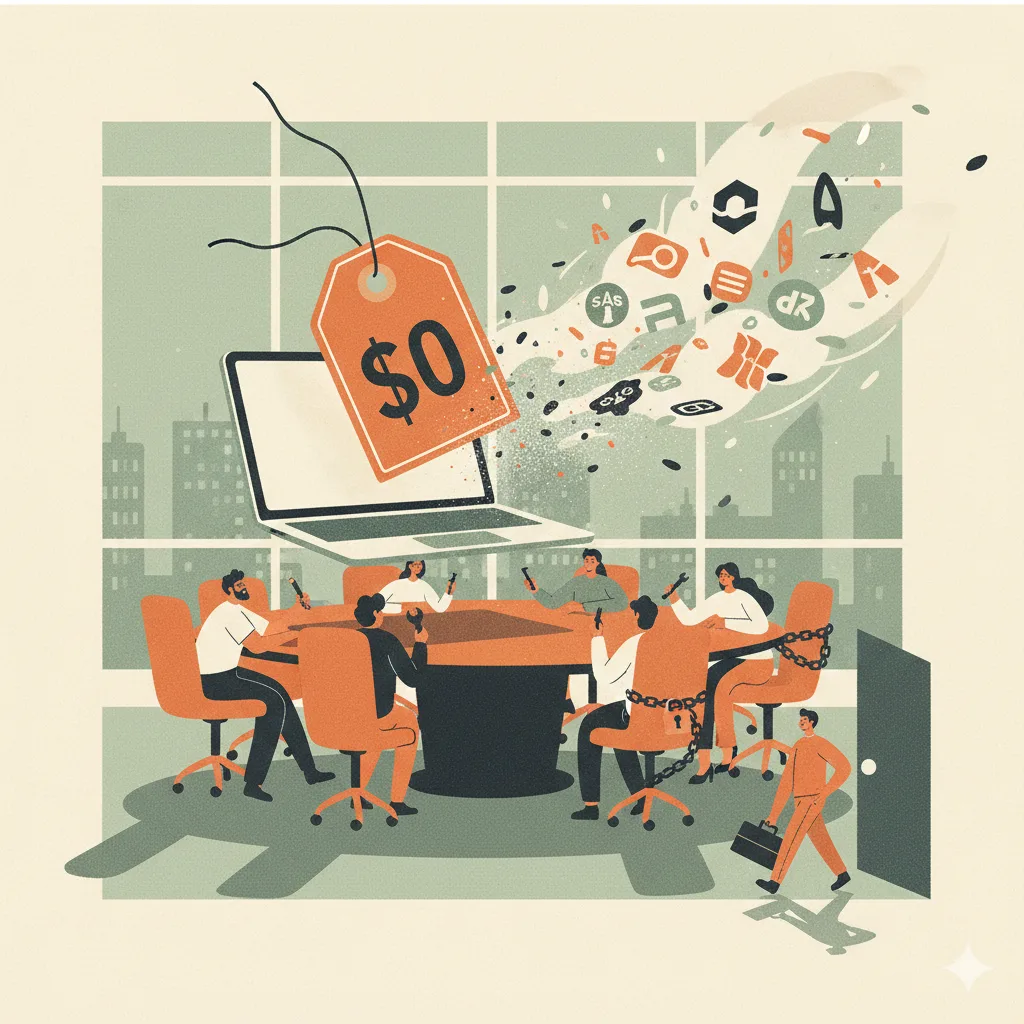
The Premise
Here's the fundamental thing that everything else in this post flows from: AI has made software absurdly cheap to build. Not incrementally cheaper. Not "we saved 20% on development costs" cheaper. Fundamentally, structurally, irreversibly cheaper. What used to take a team of engineers months can now be done by one person in days, at high quality and exceptional speed.
That single fact, the near-total collapse in the cost of creating software, is about to reshape everything. Business models, pricing, intellectual property, open source, employment, entire industries. Once you accept this premise, the rest of what I'm about to say becomes almost inevitable.
And if you don't accept it yet, you will. Because the companies that already have are coming for your market share.
The Death of Software IP
For decades, software was expensive. Salaries, infrastructure, time, it all added up. And because it cost so much to build, we assigned enormous value to the software itself. Intellectual property in code became a pillar of corporate valuation. Entire legal departments existed to protect it. VCs valued startups partly on the basis of their proprietary codebase. It made sense. If it cost you five million to build something, the code itself carried that investment.
But what happens when anyone can build the same thing for a fraction of that cost? What happens when a smart person with an AI agent can replicate your core product in a weekend?
The answer, increasingly, is: not much. Software IP as a meaningful competitive moat is evaporating. Not because the code got worse, but because the barriers to creating equivalent code have collapsed. When the thing you're protecting can be reproduced cheaply and quickly by anyone with the right tools, the protection itself becomes performative.
The IP Paradox
Here's the part that makes me genuinely frustrated. Right now, in 2026, I'm hearing from engineers and leaders at large enterprises who are locking down more AI tools than they're opening up. Entire compliance departments are working overtime to restrict which tools developers can use, which models they can access, where their code might end up in some training pipeline.
The fear is understandable in theory: "What if our proprietary code leaks into a model? What if we violate someone's IP by using AI-generated code?"
The irony is brutal: they're protecting intellectual property that has already lost most of its value, while missing the window to build the things that actually create lasting advantage, speed, iteration, market position, customer trust.
At AutoUncle, we take a radically different approach, one I described in the message to my engineering team that started this whole conversation. We have an extremely liberal AI policy. Everyone is encouraged to use whatever tools work for them, Claude Code, Cursor, ChatGPT, pick your poison. We share openly. We move fast. And the nature of our work means we aren't sitting on some mythical codebase that needs guarding. We're building products. The value is in what we ship, how fast we iterate, and the relationships we build with our customers.
Meanwhile, the companies debating compliance frameworks for another quarter are falling behind. And here's the thing: it's not just about being slower on technology. It's about everything that accumulates while you're moving. The market share. The brand recognition. The operational efficiency. The institutional knowledge of how to work with AI.
By the time the cautious ones flip the switch and onboard the AI tools, and they will, eventually, the early movers won't just be ahead on tech. They'll own the market position. And that gap doesn't close easily, because the advantage isn't in the tools anymore. It's in everything you built while the others were debating.
The Digital Artifact Problem
So if IP isn't in the code itself, where does value live? To answer that, we need to think about what software actually produces, and which outputs are about to get hammered.
Software that exists to produce a digital artifact, an image, a document, a render, a report, is in serious trouble. These are the products where the value proposition is the output itself: you put something in, you get a digital thing out. Think Photoshop. Think Canva. Think a hundred SaaS tools that generate PDFs, create presentations, edit video.
The problem is simple: if the output is digital and the spec is describable, an AI can do it. And not in a "sort of okay" way, in a "better, faster, and cheaper" way. Why would you pay premium seat pricing for a tool that produces something you can get from an AI agent in seconds?
This is a race to the bottom on price. And it's already happening. Every SaaS product whose core value is producing a digital artifact needs to ask itself a very uncomfortable question: what am I actually selling that can't be replicated by a prompt?
What Survives
Not everything is doomed, obviously. Some categories of software will retain significant value, but the reasons are illuminating.
Products tied to physical experience. Games, for instance. The value of a game isn't in the artifact it produces, it's in the experience of playing it. The entertainment, the social connection, the flow state. AI can generate assets and even help build game mechanics, but the experience itself is the product. That's harder to commoditize.
Products that solve physical-world problems. Shopping, logistics, booking, marketplace coordination. These aren't just software, they're software wrapped around a physical supply chain. The front-end interface might be trivially reproducible, but the underlying relationships, infrastructure, and operations aren't.
Think about Netflix. Anyone can build a streaming interface that looks good, a few prompts and an evening's work could get you there. But Netflix's real IP isn't the player or the recommendation UI. It's the content deals they've negotiated with studios. It's the physical servers placed at edge locations and ISPs across the world to ensure smooth delivery. It's the infrastructure underneath that took a decade and billions of dollars to build.
Products with deep ecosystem moats. Platforms that have built network effects, marketplace dynamics, or integration ecosystems that are genuinely hard to replicate. Not because the code is complex, but because the human and business relationships are.
Open Source: Explosion and Consolidation
If software itself is cheap to build and hard to protect, shouldn't we just open-source everything?
The numbers suggest the market is already moving that way. There's been an enormous spike in new open-source libraries, many of them surprisingly high quality, because people can now build and ship a package in an afternoon that used to take weeks. The barrier to contributing has collapsed just like the barrier to building.
But more doesn't mean better. The explosion of options is already creating a signal problem. When there are fifteen charting libraries and eight state management solutions, how do you choose? The answer, I think, is that we'll see a brutal consolidation. Not towards the most popular or the most polished, towards the ones that genuinely make AI-assisted development faster.
The open-source libraries that survive will be the ones that reduce token usage, that have minimal DSLs but deliver immense power, that cut the cost of AI-generated software even further. A library that saves your AI agent context tokens every time it generates code? That's the new definition of a great dependency. One that's just someone's opinion about how things should look? That's noise.
Survival of the fittest, but fitness is now measured in tokens saved and productivity gained, not in stars on GitHub.
Beyond Software
Everything I've said so far is about software. But software is just phase one, the canary in the coal mine. The same dynamics are about to hit every white-collar domain.
Legal. Finance. Accounting. Consulting. Science. Any field where the core work involves producing intellectual output, documents, analyses, reports, recommendations, is going to face the same commoditization that software is experiencing right now. Because AI doesn't just write code. It writes contracts. It analyses financial data. It reviews compliance documents. It does it faster, more comprehensively, and increasingly at higher quality.
I wouldn't be surprised if the number of people in traditional engineering roles drops to 40% of today's workforce within just a few years. Not through mass layoffs necessarily, through natural attrition, fewer new hires, and restructured teams that do more with fewer people. In fields like legal, where the work is heavily oriented around producing digital artifacts, contracts, briefs, filings, the reduction could be even steeper. Maybe down to 20% of today's headcount.
These numbers sound extreme. But think about the incentives. The biggest expense in intellectual work is manpower. If a company can produce the same or better quality output at faster speed with 60% fewer people, and AI makes that possible, then companies led by financial goals (which is most of them) will make that choice. They'll shrink expenses, increase margins, and either pocket the difference or lower their prices to win market share.
This isn't something I say lightly or happily. These are real people with real careers and real families. But pretending it isn't happening, or pretending the financial incentives don't point this way, doesn't help anyone. The most useful thing we can do is be honest about it so people can prepare.
So what happens to all those people? Do they just end up unemployed?
I don't think so. And we've actually seen this play out before. The Industrial Revolution eliminated entire categories of work, hand-spinning employed roughly 8% of Britain's population in the 1770s, and it was essentially gone within a few decades. The transition was real and it was painful. People lost livelihoods. Communities were upended. But it didn't produce permanent mass unemployment. New industries emerged. New kinds of work appeared that no one could have predicted. The overall economy grew, and eventually more people were employed than before, just doing completely different things.
The adjustment period was brutal, though. It took decades, not quarters. And that's the honest caveat: the fact that things worked out in the long run doesn't mean the short run was easy. It wasn't. But the pattern across every major technological revolution, mechanisation, electrification, computing, has been the same: work transforms, it doesn't disappear. The nature of what people do shifts dramatically, but the total amount of work that needs doing tends to grow, not shrink.
What I think will happen this time is similar. The roles that shrink will be the ones where the core output is a digital artifact, code, contracts, reports, analyses. The roles that grow will be the ones that involve judgement in messy real-world contexts, human relationships, physical work, creative direction, and the kind of strategic thinking that requires skin in the game. The person who used to write the contract will become the person who negotiates it. The engineer who used to implement features will become the person who decides what to build and why. And as I argue inThe Feedback Loop, AI is already democratizing the feedback loops that used to require expensive urban proximity, which might reshape not just individual roles, but entire assumptions about where productive work can happen.
Will every displaced knowledge worker land softly? No. Some transitions will be hard and some people will struggle. But the idea that we're headed toward a world where 60% of today's white-collar workforce has nothing to do. I don't believe that. They'll have different things to do. And if history is any guide, some of those things will be better than what they were doing before.
The Window
So here's the bottom line. We're in an opportunity window right now. It's open, but it won't stay open forever.
The companies that accepted the new reality early, that software IP is fading, that AI tools should be embraced not feared, that the value has migrated from code to brand and relationships and physical infrastructure, those companies are building an advantage that compounds every day. They're shipping faster. They're iterating faster. They're learning faster. And they're building the market share, the brand equity, and the operational muscle that will be nearly impossible to catch up to.
The companies that are still debating compliance frameworks, restricting AI tools, and clinging to the idea that their codebase is their competitive moat? They're burning daylight. And every day they spend in that debate, the gap widens.
The irony is this: when they finally do flip the switch and go all-in on AI, which they will, because the economic pressure will become impossible to ignore, the technology part will be easy. You can onboard AI tools in a week. But you can't recover years of lost market position, lost brand-building, and lost institutional learning. That's the real cost of waiting.
The price of software just hit zero. The question is what you do next.
If you lead an engineering team navigating this shift, I've written about the emotional side of the transition, the guilt senior developers feel when the rules they upheld become obsolete. For the practical playbook on building with AI, the AI Cookbook covers the principles and tactics I use daily. And if you're ready for the mindset shift on how quality works in an AI-first world, Don't Just Tell It. Enforce It. is about replacing rules with automated guardrails, and why the economics have never been better for doing so.
For the structural counterpart of this argument, what happens to the SaaS UIs themselves once AI removes the need to use them, see Database in a Trenchcoat.