The Argument Everyone Makes
Every time a major technology arrives, the same debate erupts: will this destroy jobs or create them? And every time, the optimists point to history. The printing press, the steam engine, the personal computer, the internet, each one eliminated entire categories of work, and each one ended up creating more jobs than it destroyed. The economy adapts. New industries emerge. The labour market finds a new equilibrium.
It's a powerful argument, and it has centuries of evidence behind it. So when people like me say that AI is going to fundamentally reshape our work market, that it will cost a lot of positions, that it's not just a productivity tool but a structural shift, the response is predictable. We get told we're being alarmist. That we're ignoring the lessons of history. That technology always creates more than it destroys.
I think this time might be different. Not because I'm smarter than the historians, but because the nature of what's being automated is different. Previous technological revolutions automated physical work, mechanical work, routinework. AI automates cognitive work. Judgement. Analysis. Drafting. Research. Communication. The tasks that define the knowledge economy. We've never seen a technology that goes after the thinking itself. And the historical playbook for what happens next is, at best, uncertain.
I'm not alone in thinking this. On a recent episode of the Danish podcast AI Revolutionen, investor Mikkel Rosenvold put it bluntly: he believes we'll see net fewer jobs, at least in the short term. He knows it goes against the classical thinking. But when he looks at the US data, economic growth that simply isn't producing jobs, he can't find another explanation. The economy is growing, but the employment isn't following. Something is absorbing the work that would normally create positions. And the most obvious candidate is AI.
And here's the thing people keep getting wrong about timing: this is not a five-to-ten-year prediction. The technology is already here. The tools are already capable. Companies that have adopted AI are already seeing enormous productivity gains. What we're waiting for is not better AI, it's for the rest of the market to open their eyes to what's already possible around them. When they do, it could move much faster than anyone expects.
But this isn't an article about predictions. It's about what's already happening, and why almost nobody can see it.
Why Nobody Feels It. Yet
If AI is really reshaping the labour market, where's the evidence? Companies are still hiring. Unemployment isn't spiking. The economy looks … normal. People who warn about what's coming get treated as conspiracists, or at best, as people who just can't stop talking about AI.
I think the reason we're not feeling the consequences is deceptively simple: not hiring people doesn't feel the same as firing them.
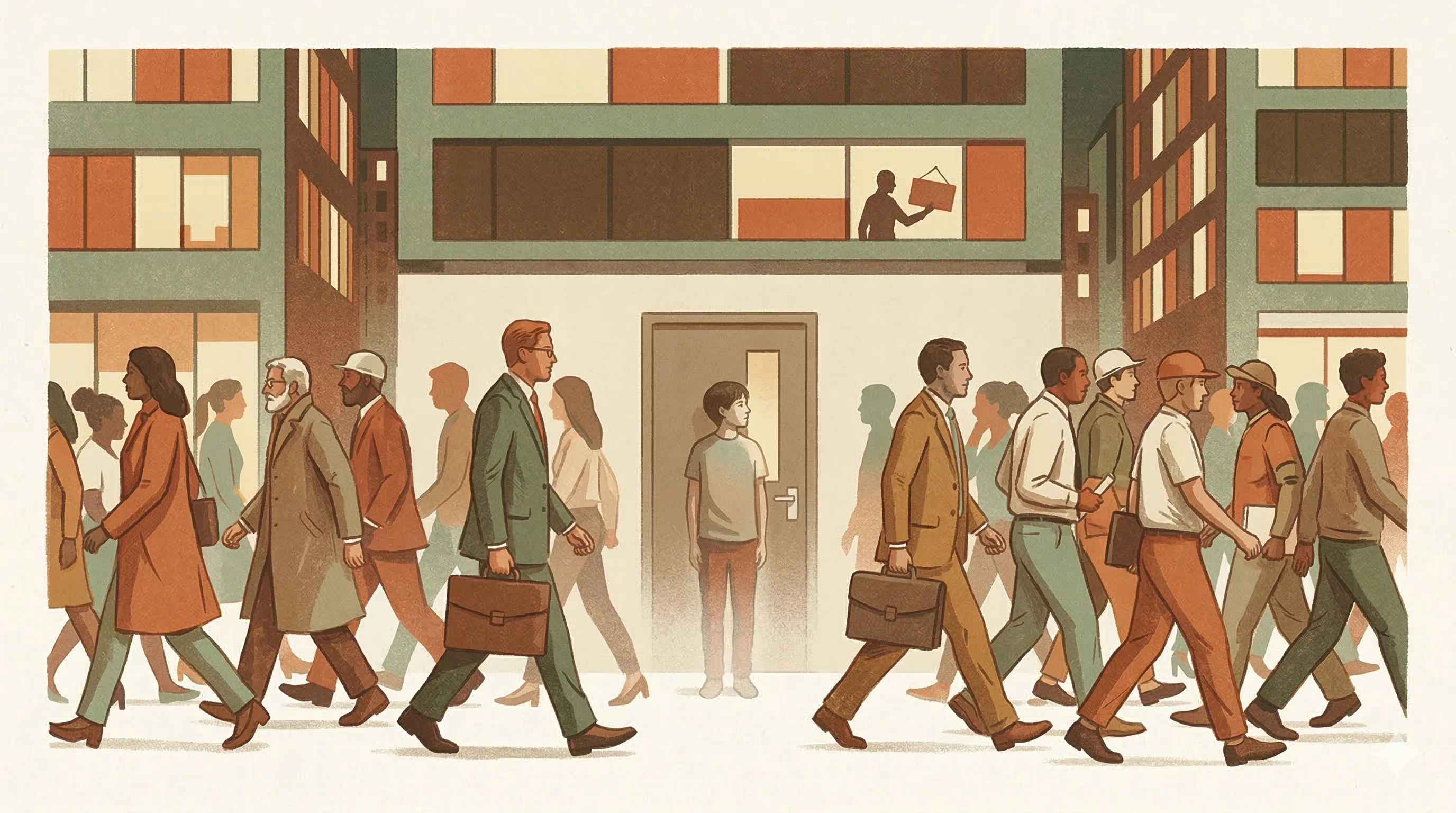
When a company lays off 200 people, it makes the news. There are headlines, union responses, political debate. When a company quietly fills three out of five graduate positions instead of five, nothing happens. No headline. No debate. No sense of crisis. The people who didn't get hired don't form a visible group. They just … don't arrive.
That's why the job market looks fine. Companies are still hiring. They're hiring seniors, people who can direct AI, set up the workflows, see the big picture and delegate the execution. It's the excavator analogy I keep coming back to: companies desperately need operators who know how to drive the machine. But they're not hiring the people who would have done the digging by hand. The entry-level roles, the graduate positions, the junior seats, those are the ones quietly disappearing.
The first casualties of a technology shift aren't the people who lose their jobs. They're the people who never get offered one. That's a much harder thing to see, and a much easier thing to deny.
These are the silent casualties. No one marches in the street because they didn't get a callback. No union files a grievance when a company decides to hire two people instead of five. The pain is real, but it's invisible. And because it's invisible, the people raising the alarm get dismissed.
The Numbers
On March 16, 2026, today, a group of researchers from Örebro University, the RATIO Institute in Stockholm, Aarhus University, and the Kiel Institute in Germany published a working paper with a title that deserves attention: Same Storm, Different Boats: Generative AI and the Age Gradient in Hiring.
The paper, led by Magnus Lodefalk, uses 4.6 million job advertisements from Sweden's largest recruitment platform and full-population employer register data from Statistics Sweden. It's not a survey. It's not speculation. It's one of the most comprehensive empirical studies to date on how generative AI is already reshaping the labour market, and the findings confirm exactly what I've been worried about.
The headline: young workers in AI-exposed occupations are being disproportionately displaced. By early 2025, employment of 22–25-year-olds in high-AI-exposure occupations had fallen 5.5 per cent relative to less exposed occupations, within thesame employers. Meanwhile, employment of workers over 50 in those same occupationsrose by 1.3 per cent.
Read that again. The same companies, the same occupations. But the age composition is shifting. Employers aren't reducing their workforce, they're changing who they hire.And the adjustment burden falls overwhelmingly on those just entering the labour market.
The researchers call young workers "the canaries in the coal mine", and the metaphor is apt. The age gradient is monotonic: the younger you are, the harder you're hit. The 26–30 group shows a 4.9 per cent decline. The effect progressively weakens for older groups. And it's roughly twice as large for young women as for young men.
This isn't a recession effect. The researchers use a clever natural timing test: Sweden's Riksbank began raising interest rates in April 2022, seven months before ChatGPT launched. If the decline were driven by monetary tightening, it would begin in mid-2022. Instead, the employment gap specifically in AI-exposed occupations begins to widen after ChatGPT and accelerates through 2024 and into 2025. The timing points to AI, not the economy.
The full paper is available here: Lodefalk et al. (2026), Same Storm, Different Boats (RATIO Working Paper No. 388).
The Pipeline Paradox
This is where it gets really uncomfortable. If junior positions disappear because AI can do the tasks those positions existed to perform, we lose something more than jobs. We lose thepipeline through which people become experienced.
You don't become an architect by reading about architecture. You become one by building things, making mistakes, having someone senior tell you why it won't work, and trying again. Entry-level work isn't just cheap labour, it's a training ground. It's where people develop the tacit knowledge that eventually makes them indispensable.
If AI removes that training ground, we face a paradox: the very thing that makes senior workers valuable, their accumulated human judgement, can't be developed in the next generation because there are no junior roles left to develop it in. It's a slow-burning crisis that won't show up in next quarter's employment statistics. But it will show up in ten years when we ask: where did all the experienced people go?
I've written about a related dynamic in The Feedback Loop, how proximity and access to challenge shape what people can become. This is the same pattern, playing out inside organisations rather than across geography.
The First Wave, and the Next One
I think a lot of people are reading data like this and thinking: "OK, so the seniors are safe." They're not. This is just the first wave.
Here's what's actually happening. Companies are in a transition phase. They need people who can direct AI, who can set up the workflows, who can see the big picture and delegate the execution. That's senior work. It's the excavator analogy I keep coming back to: right now, companies desperately need operators who know how to drive the machine. So they're hiring experienced people, and they're not hiring the juniors who would have done the digging by hand.
But transition phases end. Once the AI workflows are in place, once the systems are running, once the orchestration patterns are established, companies will look around and ask a different question: do we still need this many operators?
The reason senior employment is rising in AI-exposed occupations isn't because AI can't replace senior work. It's because we're in the deployment phase. Companies are building the infrastructure. They need the architects. But when the building is done and the system is running, you don't keep the full construction crew on payroll.
Mikkel Rosenvold describes the radical version of what's coming: take a team of ten to twelve people, find the best specialist, give them all the AI licences they need, and let the rest go, including the manager. He's seeing this pattern in the US tech sector already, where employees are increasingly treated as embedded entrepreneurs rather than cogs in a workflow. It sounds extreme, but the logic is straightforward once AI handles the execution layer.
And the dynamic won't be gentle. As Rosenvold puts it: companies will fire first and figure it out afterwards. When competitors start cutting costs through AI, the pressure to follow becomes existential. He predicts double-digit layoff rounds, in percentage of headcount, at large Danish banks within one to two years. Media. Insurance. Auditing. Every major office-based sector.
But it matters enormously where you look. This second wave won't hit evenly. It will hit hardest in the large corporates, the banks, the consultancies, the insurers, the media conglomerates. Organisations with thousands of employees, layers of management, and owners whose primary lens is asset optimisation. Fund-owned companies. Publicly traded companies. Places where the distance between leadership and the actual work is measured in reporting layers, not hallway conversations. That distance makes it easy to see headcount as a line on a spreadsheet. And spreadsheets are exactly what AI is good at optimising. In a fund-owned enterprise with 4,000 employees, it's a portfolio decision to let people go. And when the AI business case lands on the board table showing that you can maintain output with 30 per cent fewer people, the conversation is short. That's where I preditct the second wave will break first, and hardest.
So the pattern will be two waves. The first wave, happening now, largely invisible, hits the young. They don't get hired. The pipeline dries up. The second wave will come when companies have their AI capabilities in place and begin to realise they need fewer people across the board. That wave won't be invisible. But by then, we'll have lost years of preparation time.
Sweden Is Already Having This Conversation
Here's what struck me hardest about this research: it exists because Sweden has built the institutional infrastructure to produce it.
In 2025, AI Sweden, Sweden's national centre for artificial intelligence, establishedArbetsmarknadens AI-råd (the Labour Market AI Council). It brings together trade unions, employer organisations, and transition agencies, Akavia, Almega, Ciko, DIK, Fremia, Svensk Handel, and Unionen, to build a shared, evidence-based picture of how AI is transforming the Swedish labour market.
The council has already published two insight reports. The first, En arbetsmarknad i rörelse (A Labour Market in Motion, November 2025), established a baseline: 76 per cent of working professionals use AI at work at least once a year. Regular use (weekly or daily) jumped from 29 to 49 per cent between 2024 and 2025. The private sector is ahead, 62 per cent regular users, but the public sector is catching up at 45 per cent.
But the reports aren't just about adoption numbers. They highlight a structural tension that resonates deeply with what I see in my own work: usage is running ahead of structure. People are using AI every day, but the organisational frameworks, strategies, policies, training programmes, data governance, are lagging behind. Two thirds of Swedish professionals say they need AI-related skill development within one to two years. Only a quarter say their employer has a plan for it.
The second report, Framtidens arbete (The Future of Work, February 2026), goes deeper. It synthesises international research alongside the partners' practical observations and lands on three critical insights: Sweden needs better data to understand AI's impact; a long-term collaboration structure between research and labour market parties is necessary; and scenario planning is needed to build preparedness.
Underpinning this work is Magnus Lodefalk's research, the same researcher behind the "Same Storm, Different Boats" paper. Sweden isn't just talking about AI. It's measuring it, studying it, and building institutional capacity to respond.
And in Denmark?
I keep looking for the Danish equivalent. I can't find it.
We don't have a national AI council focused on labour market transformation. We don't have a systematic collaboration between trade unions and employer organisations producing shared analyses of how AI is reshaping work. We don't have population-level register studies tracking AI's impact on hiring composition. We don't have the institutional infrastructure that Sweden has built, and we need it.
What we do have is an election campaign where AI is virtually absent from every debate. The hosts of AI Revolutionen describe it as screaming to heaven: party leader debates with zero AI discussion, no proposed solutions, no acknowledgement that the labour market their policies target might look fundamentally different in eighteen months. When AI did briefly surface in one debate, a politician suggested that "logo designers" might be affected. That was the depth of the conversation.
This isn't surprising. Politics is reactive. Solutions emerge when problems become visible. And the problems aren't visible yet, because, as I've argued, the first casualties are silent. But it's also a failure of media. The journalists asking the questions aren't pressing politicians on what their plans are when double-digit layoff rounds start hitting the banks and the insurance companies. They should be. The technology isn't coming. It's here. The only question is how fast organisations act on what's already possible.
This isn't about Sweden being better. It's about Sweden being earlier. And in a domain where the pace of change is measured in months, earlier matters enormously.
I wrote recently about what I believe is coming for the Danish public sector, how AI-equipped citizens will overwhelm public institutions that don't have access to the same tools. That was me speculating based on what I see in my daily work. The Swedish research takes that speculation and grounds it in data. The shift is already happening. It's measurable. And Denmark is flying blind.
What the Swedish Model Shows Us
The Swedish approach through Arbetsmarknadens AI-råd is instructive precisely because it mirrors the Nordic model of dealing with structural change: bring the parties together, build shared understanding, let evidence drive action.
Sweden has a history of managing technological transitions this way, from industrial automation through digitalisation, through close cooperation between labour market parties, active skill-building, and clear division of responsibility between employers, unions, and the state. The AI council is an extension of that tradition.
And the approach is already yielding actionable insights. From the first report alone: 60–70 per cent of tasks in the service sector can be partially performed by AI. But the effect is primarily transformation of roles, not elimination. 81 per cent of professionals see a need to develop AI skills, but only 32 per cent have been offered training. There's a gap between ambition and support that the market won't close on its own.
Denmark has the same tradition of social partnership. We have strong trade unions, active employer organisations, and a deeply embedded belief in coordinated transition. What we lack is the specific initiative, the dedicated forum where these actors come together specifically to understand and respond to AI's impact on work.
Two Conversations, Not One
I've been writing on this blog about the human side of AI transformation. About what it means whenthe thing you spent years mastering becomes automatable. About the emotional work of letting go. Abouthow teams navigate the shift from using AI as a tool to AI as a way of working.
But the Swedish research adds something those posts don't address: this isnot equally distributed. "Same storm, different boats" is exactly right. The storm is hitting everyone, but the boats are different sizes. And right now, the smallest boats belong to the youngest workers.
We need two conversations. The corporate one about how to work differently, and the societal one about who bears the cost of transition. The corporate signals are clear: Google's >50% AI-generated code, Suleyman's 18-month prediction, OpenAI's million-line zero-human-code experiment. The Lodefalk paper gives us the societal signal: the labour market is already adjusting, and not equally. Sweden is having both conversations. Denmark, as far as I can tell, is barely having the first.
A Call for a Danish AI Labour Market Council
I don't have the position or the mandate to create institutions. But I have a platform, and I have a voice. So here's what I think needs to happen:
Denmark needs its own version of Arbetsmarknadens AI-råd. A dedicated forum where trade unions like HK, Djøf, IDA, and Dansk Metal come together with employer organisations like DI and Dansk Erhverv, supported by researchers who can bring the kind of evidence that Lodefalk's team is producing in Sweden. Not a technology council. Not a digitalisation strategy. A specific, ongoing initiative focused on understanding and responding to how AI is transforming the Danish labour market.
The Swedish council isn't expensive. It's not a massive bureaucratic undertaking. It's AI Sweden (a non-profit with 170+ partners and 80 people), a handful of committed organisations, and a willingness to sit at the same table and look at the evidence together. Denmark has every institutional prerequisite to do the same.
What we lack is urgency. And that's exactly what the research should provide.
5.5 per cent. That's the employment decline for young Swedes in AI-exposed occupations, in just two years. We don't know what the Danish number is. We don't know because nobody is measuring. That needs to change.
Further Reading
The research paper:Lodefalk, Löthman, Koch & Engberg (2026): Same Storm, Different Boats: Generative AI and the Age Gradient in Hiring, RATIO Working Paper No. 388.
The Swedish AI Labour Market Council:Arbetsmarknadens AI-råd at AI Sweden.
AI Revolutionen podcast:Episode with Mikkel Rosenvold, Danish-language discussion on AI's impact on jobs, stock markets, and why the political conversation hasn't started.
My prediction for the Danish public sector:Min forudsigelse: AI vil drukne det offentlige i arbejde, a Danish-language op-ed on the asymmetric burden AI will place on public institutions.